
If you have ever Googled "am I a healthy weight," you have seen the two dominant tools: a BMI calculator and a Body Visualizer. They look similar — both take height and weight, both spit out a result — but they answer very different questions. This post explains where a Body Visualizer beats BMI, where BMI still wins, and when you should reach for one over the other.
If you want to skip ahead and try a free Body Visualizer right now, jump to body-visualizer.net. Otherwise, keep reading.

What Each Tool Actually Is
A BMI calculator is a single formula: weight (kg) / height (m)^2. That is it. You get one number, which is then bucketed into "underweight / normal / overweight / obese."
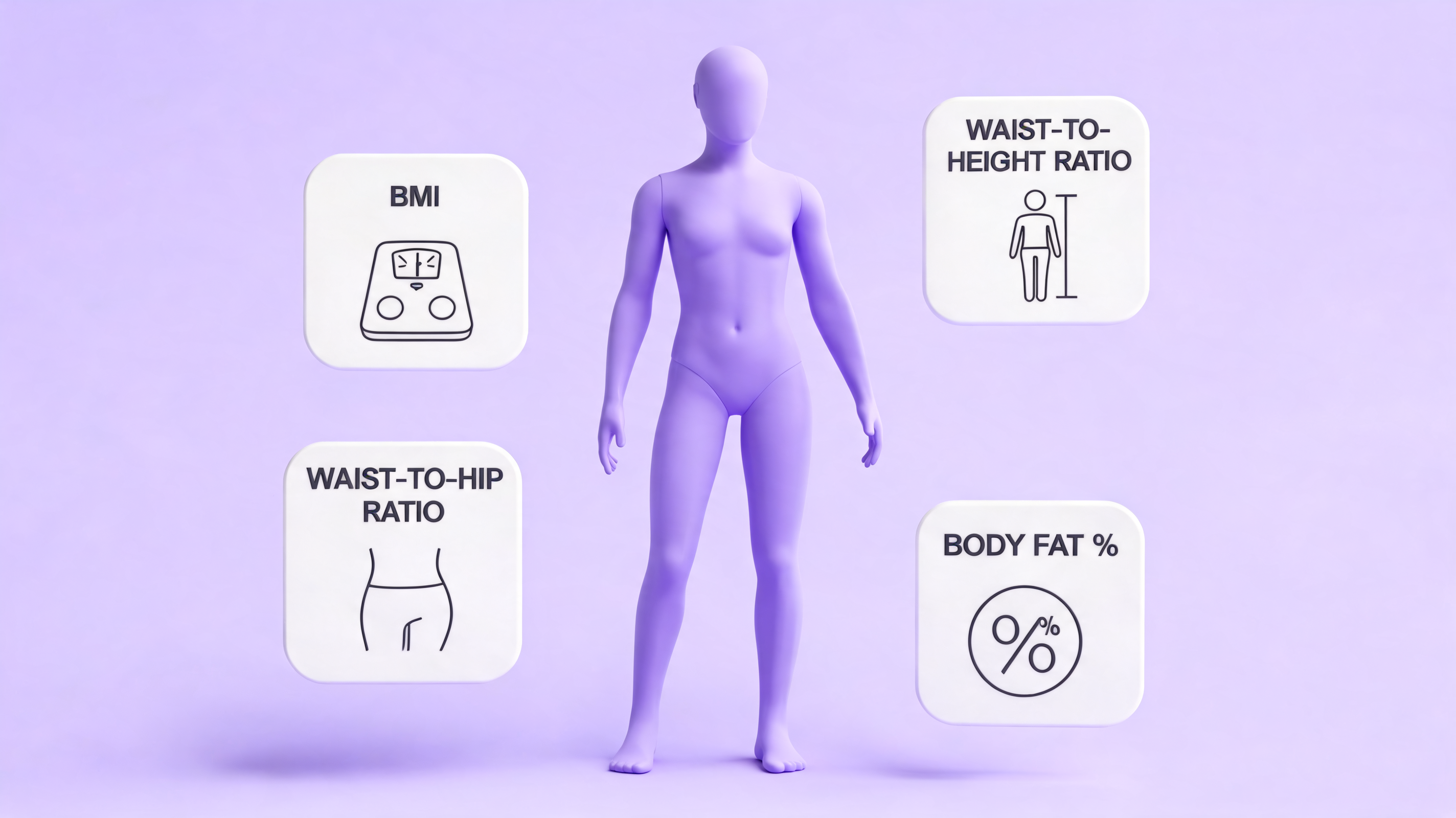
A Body Visualizer is a 3D body shape tool. It takes the same height and weight, but it also accepts chest, waist, hips, and inseam — and turns the result into a visual silhouette plus several derived metrics. A Body Visualizer typically reports BMI, Waist-to-Height Ratio (WHtR), Waist-to-Hip Ratio (WHR), an estimated body fat percentage, and a body-shape label.
So in short: every Body Visualizer contains a BMI calculator, but a BMI calculator contains only itself.
What BMI Gets Right
Despite its critics, BMI has real strengths:
- Universal. Every clinician on earth understands BMI cutoffs.
- Cheap. Two measurements, no equipment.
- Population-grade signal. Across millions of people, BMI correlates with health outcomes.
If your only goal is a single comparable number for medical paperwork, a BMI calculator is the right tool. A Body Visualizer cannot replace that institutional role.
Where BMI Falls Short — and a Body Visualizer Helps
BMI's weaknesses are well known:
- It cannot tell muscle from fat. A muscular athlete and a sedentary person at the same BMI look completely different — and a Body Visualizer makes that difference visible.
- It cannot tell where the fat is. Central fat (around the waist) is a different risk profile from peripheral fat (hips/legs). A Body Visualizer captures this via WHR and WHtR.
- It is an abstract number. A Body Visualizer lets you actually see a shape, which most people find easier to interpret.
This is the core pitch for any Body Visualizer: same inputs, more dimensions of output, fewer false readings.
Body Visualizer vs BMI: Feature Comparison
| Feature | BMI Calculator | Body Visualizer |
|---|---|---|
| Inputs height & weight | ✅ | ✅ |
| Inputs waist / hips / chest | ❌ | ✅ |
| Renders a 3D shape | ❌ | ✅ |
| Reports BMI | ✅ | ✅ |
| Reports WHtR | ❌ | ✅ |
| Reports WHR | ❌ | ✅ |
| Estimates body fat % | ❌ | ✅ |
| Goal comparison | ❌ | ✅ |
| Works without an account | ✅ | ✅ |
| Medical instrument | ❌ | ❌ |
The takeaway: a Body Visualizer is BMI plus four extra signals plus a 3D viewport. The downside is a slightly longer setup — a Body Visualizer needs a tape measure.
When to Choose a Body Visualizer
Reach for a Body Visualizer when:
- You want to see what a change would look like. Sliders are far more intuitive than mental arithmetic on BMI deltas. A Body Visualizer is built for this.
- You want shape information, not just mass. Two people at BMI 26 with very different waists will get very different Body Visualizer outputs.
- You are setting fitness goals. The Body Visualizer's goal comparison shows whether a target is actually visible.
- You are sensitive to BMI's blunt categories. A Body Visualizer outputs a continuous, multi-dimensional view instead of a single label.
When to Choose Plain BMI
A standalone BMI calculator is fine when:
- You only need one number for a form or a doctor's intake.
- You do not have access to a tape measure.
- You do not want to bother with 3D rendering — though a modern Body Visualizer renders in well under a second on any device.
In practice, even when BMI is enough, opening a Body Visualizer costs nothing extra and gives you the BMI plus the other metrics for free.
Body Visualizer vs Body Fat Calculator
Some people compare a Body Visualizer to a body fat percentage calculator instead. A body fat calculator usually uses one of several formulas (Navy, Deurenberg, YMCA) and outputs a single number. A Body Visualizer typically uses the Deurenberg formula under the hood and shows the same estimate — plus the 3D preview and the other ratios. So a Body Visualizer is generally a superset of a body fat calculator, too.
Accuracy: Is a Body Visualizer More Accurate Than BMI?
This is a subtle question. A Body Visualizer is not more accurate in a medical sense — both tools are estimates. But a Body Visualizer is more informative, because it uses more of your data. With waist included, a Body Visualizer can flag central adiposity that BMI alone would miss. With hips included, a Body Visualizer can describe distribution, which a BMI calculator literally cannot represent.
So: a Body Visualizer does not magically know more biology. It just uses more of what you already have on a tape measure.
Limitations Both Tools Share
It is fair to call out where a Body Visualizer and a BMI calculator are both wrong-shaped for the job:
- Neither is a medical device.
- Neither replaces a clinician, a DEXA scan, or a Bod Pod.
- Neither should be used to assess eating disorders or to make weight-loss decisions in isolation.
- Both depend entirely on the accuracy of what you type in — a Body Visualizer cannot validate your numbers.
Treat the Body Visualizer (and BMI) as an informational lens, not a verdict.
So Which Should You Use?
If you only need one tool, use a Body Visualizer. A Body Visualizer gives you BMI plus everything BMI is missing, in the same screen, in the same minute, for free. The 3D preview alone is worth the extra inputs.
If you want the simplest possible answer, a BMI calculator is still fine — just be honest with yourself about its blind spots.
👉 Try the Body Visualizer and see for yourself how much richer the picture is than a BMI number alone.